Plastic theatre
The Glass MenageriePlastic theatre is Tennessee Williams’s name for a stage practice that uses more than realistic dialogue and lifelike objects to represent experience. Its decisive claim is that theatrical transformation can approach reality more deeply than photographic likeness: movement, light, music, projected images, and carefully composed stage pictures work together to make memory and feeling perceptible. In The Glass Menagerie, this language repeatedly places Laura in visual and musical focus, turning her quiet presence and the fragile glass associated with her into a central emotional thread.
Definition and Aesthetic Purpose
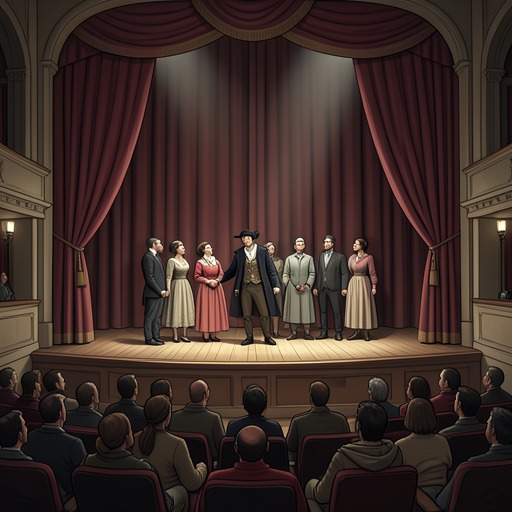
Williams developed the idea while working on plays before completing The Glass Menagerie, alongside experiments in a more fluid dramatic structure influenced by cinematic staging. He described a sculptural drama of reduced movement: actors form statuesque attitudes or tableaux, with motion pared down to what is essential or significant. The aim is not spectacle for its own sake, but a concentrated composition in which a held pose or a shift of attention can carry meaning that ordinary action might dilute.
The method draws on expressionist practice, but Williams’s account stresses its combination with romantic lyricism. He argued that unconventional techniques should move drama closer to truth, not help it evade reality or its responsibility to interpret experience. A realistic stage furnished with a genuine refrigerator and authentic ice cubes may achieve photographic resemblance, but resemblance alone cannot convey reality as an organic whole. For Williams, poetic imagination represents experience through transformation, changing appearances into forms that can disclose their emotional essence.
He presented this approach as a response to what he considered the exhausted conventions of realistic theatre, a way for drama to regain cultural vitality. The form also suited a play organized episodically around recollection: its narrative line might seem fragmentary unless theatrical signs gave the audience a way to recognize the emotional and structural connections among scenes. Plastic theatre thus acts both as a theory of representation and as a practical system for composing attention.
Stage Composition and the Screen
The stage picture is built through selective emphasis rather than a uniformly realistic view. Williams’s production notes call for atmospheric subtleties and unusual freedom of convention. The stage remains dim, while shafts of light isolate particular actors or areas, sometimes drawing attention away from the apparent center of the action. In the quarrel between Tom and Amanda, for instance, Laura has no active part, yet the clearest pool of light falls on her. The supper scene likewise keeps her silent figure on the sofa as the visual center.
Williams compares the distinct clarity surrounding Laura to light in religious portraits of female saints or Madonnas, and invokes the contrast between radiant figures and the dusky atmosphere of paintings by El Greco. This lighting does not simply reproduce the room as it would look in ordinary life. It makes Laura’s stillness legible as an emotional presence even when the dialogue and immediate action concern someone else. Selective illumination gives a relatively static drama a mobile, plastic quality by changing where the audience looks and what a stage image means.
An original version of the play also included a screen for projected magic-lantern slides: images or titles cast on a section of wall between the front-room and dining-room areas. Williams omitted the device from the acting version used in the Broadway production, deciding that Laurette Taylor’s performance made the utmost simplicity of physical production appropriate. He nevertheless retained the device in the published manuscript so readers could see how it had been conceived. The screen was intended to accent structural points in each scene, making an allusion more vivid and allowing an important idea to register without placing the whole burden on spoken lines. Williams also regarded its emotional appeal and possible uses as extending beyond the particular instances in the script.
Music, Memory, and Glass
The recurring tune called “The Glass Menagerie” supplies an aural counterpart to selective light and projected imagery. Williams describes it as a distant, persistent circus-like music that drifts in and out of consciousness: at once delicate and sad, expressive of life’s surface vivacity and an underlying sorrow that cannot be put into words. Its movement through the play is variable, as though carried by a changing wind, but its returns connect separate episodes and the narrator’s time with the subject of his story.
The tune is primarily Laura’s music. It becomes clearest when the play focuses on her and on the lovely fragility of glass, which serves as her image. Williams connects the glass to two inseparable responses: admiration for its beauty and awareness of how easily it can break. The musical recurrence therefore does more than mark transitions. It binds a sequence of remembered scenes through nostalgia while carrying the play’s central tension between brightness and vulnerability.
The same sensory logic shapes the opening recollection of Amanda’s disbelief that no gentleman callers have come. Laura nervously echoes her mother’s laughter, slips through the half-open portieres, and gently draws them closed; a shaft of clear light falls on her face against the faded tapestry as the music is faintly heard. Gesture, curtain, light, and tune create a scene whose emotional emphasis exceeds its dialogue. The stage does not merely illustrate what is said: it gives form to the unease and isolation around Laura.
The Closing Image and Dramatic Effect
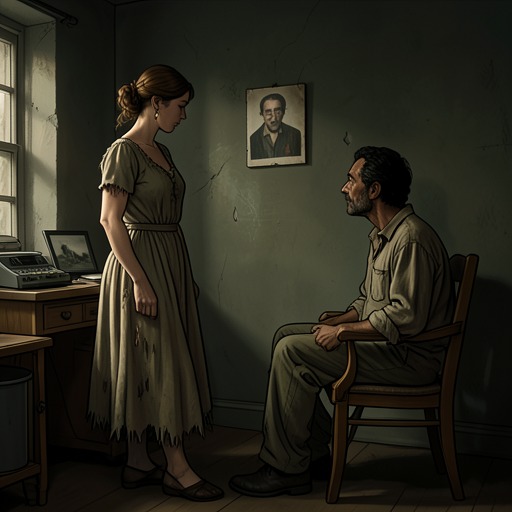
Plastic theatre’s components converge in the ending. After Tom breaks his glass and rushes onto the fire escape, the dance-hall music grows louder and moonlight illuminates him through the storm clouds. A projected legend announces a farewell. While Tom speaks, the audience sees Amanda comforting Laura inside the apartment as if through soundproof glass, but cannot hear her words. Removed from the sound that earlier made Amanda’s speech seem silly, she appears with dignity and tragic beauty; Laura’s hidden face lifts into a smile, and Amanda’s gestures move slowly and gracefully, almost like a dance.
The arrangement makes two actions simultaneous without giving them equal access to sound: Tom narrates departure, while the silent image inside the home reveals a tenderness his speech cannot contain. Amanda glances briefly at the father’s picture before withdrawing through the portieres. At the close of Tom’s speech, Laura blows out the candles, ending the play. Light, silence, gesture, music, and the final extinguishing of the candles complete an emotional argument that exposition alone could not make.
The production history also demonstrates that Williams’s theory was not a demand for maximal technical display. The original Chicago production opened at the Civic Theatre on December 26, 1944, and the New York production at the Playhouse Theatre on March 31, 1945; Eddie Dowling and Margo Jones staged the play, with setting and lighting by Jo Mielziner and original music by Paul Bowles. Although the screen was omitted from the Broadway acting version, the play’s other theatrical signs could still organize its memory-driven form. Plastic theatre’s lasting force lies in this coordinated, selective representation: the audience is asked to read a pool of light, a recurring tune, a suspended pose, or a silent gesture as part of the drama’s truth.